

 499
499 What are h1-h6 headings and what are h1-h6 tags used for on a page?
Why can the same page look clear to a reader but "chaotic" to Google—and what do headings have to do with it?
Basic Definition: What are h1–h6 Headings?
Headings (h1-h6) are HTML tags that denote the names of sections and subsections on a page. They create a hierarchy, from the main topic (h1) to the clarifying blocks (h2-h6). Simply put, h1-h6 tags are used to create a logical "skeleton" for the content, so that the text reads like a structured document rather than a continuous canvas.
How h1–h6 structure content for the user
For humans, headings are navigation and quick scanning aids. They help:
- quickly find the desired fragment;
- understand what the page and each block are about;
- improve readability and attention retention.
Why is this important for Google and SEO?
For search engines h1–h6 tags are used for Understanding the page's topic and the relationships between content elements. A proper hierarchy improves visibility in Google: it's easier for bots to "read" the main topic (h1) and subtopics (h2-h3), which supports effective SEO and systematic website promotion.
A good headline doesn't just decorate the text; it controls attention and the logic of reading.
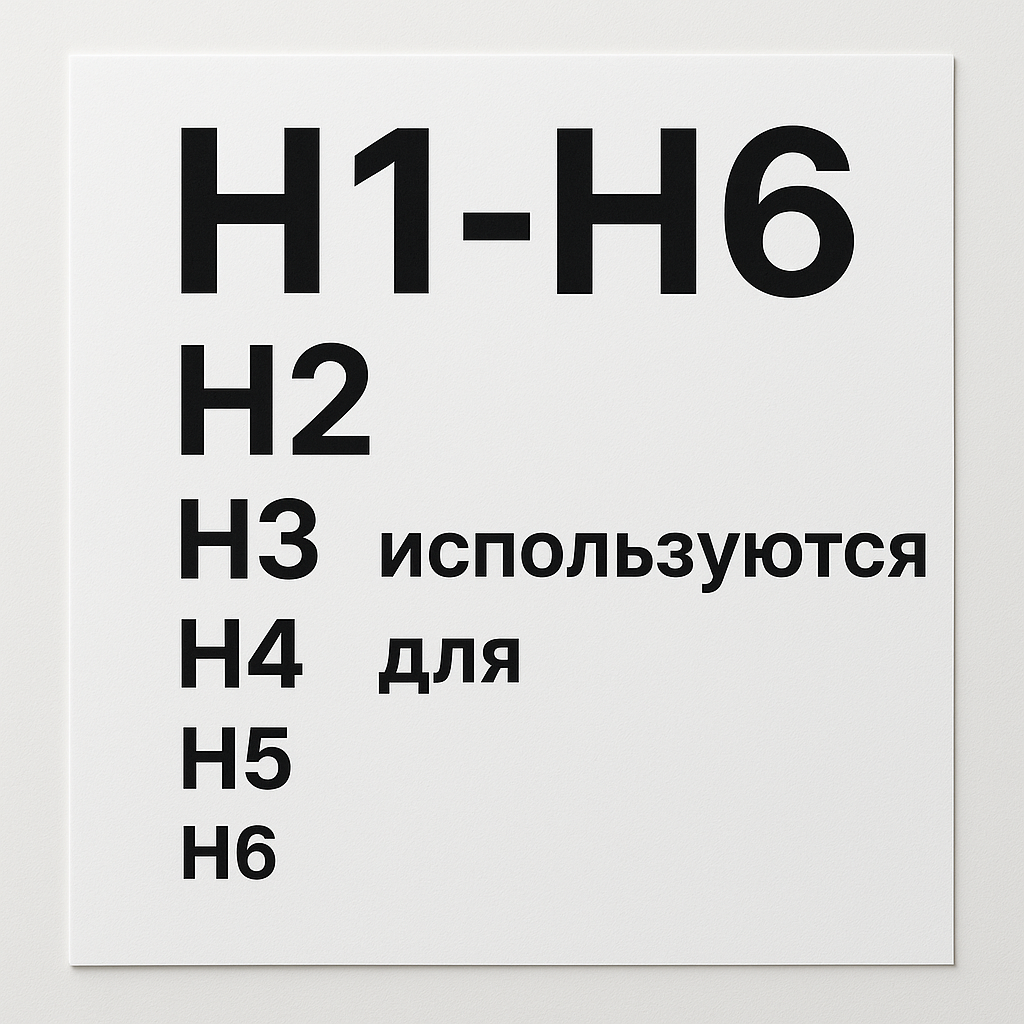
How to Use H1-H6 Headings Correctly: Hierarchy, Rules, and Common Mistakes
Heading Hierarchy: How to Build Page Logic
In practical SEO, h1–h6 tags are used to create a clear structure: one main heading and sequential sub-levels. On most pages, a single H1 (page title/key topic) is sufficient, followed by H2 for larger sections and H3 for more detailed information. This allows Google to quickly "read" the topic, and helps users find answers.
Rules of use: quantity, subheadings and readability
To headings h1-h6 When working on systematic website promotion, follow these simple rules:
- do not duplicate H1 in menus/banners and other headings;
- do not skip levels (after H2 it is logical to go to H3, not H4);
- write headlines for people: short, specific, without bureaucratic jargon;
- Add keywords naturally, without spamming.
Common mistakes that reduce visibility and conversion
Most often, problems arise due to: multiple unnecessary H1s on one page, identical H2s "About Us/Services" on all pages, overly long headings and "keyword stuffing." Remember: h1–h6 tags are used for Hierarchy and clarity - this directly impacts increased visibility in Google and content readability.
FAQ: Are h1–h6 tags used for SEO or design? (Q&A)
Are h1–h6 tags used for SEO or design?
H1–h6 tags are used to structure the page content in HTML, while the design is the responsibility of CSS. This is important for SEO because it helps Google better understand the topic and subtopics, making it easier for users to read and scan the text. Headings alone won't boost a website, but as part of a systematic website promotion, they support organic traffic growth through improved relevance and behavioral signals.
Is it possible to make headings using CSS instead of h1–h6?
Visually you can do anything, but if the text is formatted as usual div or span, Google won't treat it as a heading. This means styles don't replace semantics. Best practice: use h1–h6 appropriately, and customize the appearance using CSS.
What's more important: keywords or user, and how to check titles?
Prioritize the user: the title should explain what will be in the block. Include keywords naturally, without over-spamming—then the h1–h6 tags are used to enhance Google visibility, not as a "keyword dump." You can check your titles by viewing the page source in a browser, using SEO analysis extensions, or tools like Screaming Frog/Netpeak Spider to identify structure and duplicates.
Conclusion: How h1–h6 tags help improve visibility in Google
Good headings aren't just cosmetic enhancements, but rather guide the page's logic. H1–h6 tags are used to establish a clear hierarchy: one H1 articulates the main topic, H2s expand on key blocks, and H3–H6s expand on the content where necessary. As a result, the page becomes clearer to the reader, easier to scan, and therefore easier to guide them to the desired action.
For Google, this structure signals where the main idea is and where the subtopics are, which supports increased visibility in Google and effective SEO without "magic." When you don't duplicate headings, skip levels, or overload headings h1-h6 By using keywords, you get more manageable content: it's easier to update, scale to new queries, and maintain page quality while maintaining a transparent approach to promotion. In the long term, this helps both increase organic traffic and conversion, because the structure builds trust and reduces friction during reading.
The heading structure is the page map that both humans and search engines navigate.






 Russian
  English
  Ukrainian
  German