832
832 In SEO, it's not the quantity that matters, but backlink quality. Search engines take into account not just the presence of mentions, but their reliability, link relevance And naturalness of links. Random placements burn the budget and increase the risk of sanctions. A well-thought-out strategy provides stable traffic and leads.
In this guide Web Raketa will show, how to check backlink, on what domain metrics rely on how to distinguish good vs bad links, recognize spam signals and build a natural link profile. You will receive checklists, tables and visual examples.
What is backlink quality?
Backlink quality — a combination of factors: link relevance, trust in the donor, naturalness of links, real traffic from clicks, healthy anchor structure and absence of spam patterns.
“One quality link can outweigh hundreds of weak ones.”
— Brian Dean (Backlinko)
"Good vs. Bad Links"
| Sign | Good links | Bad links |
|---|---|---|
| Source | Authoritative site (DR 70+), stable organics | Spam forum/aggregator without moderation |
| Relevance | In the same/related topic | The topic does not match your niche |
| Traffic | There are transitions, pages in the index | There are no transitions, pages are almost not indexed |
| Context | Organic insertion into the body of the material | Sales block, catalog, "link dump" |
| Anchor | Balance brand/URL/key | Overspammed exact-match |
| Attributes | Natural mix dofollow/nofollow | Artificial grids and imbalances |
How to check a backlink (methods and tools)
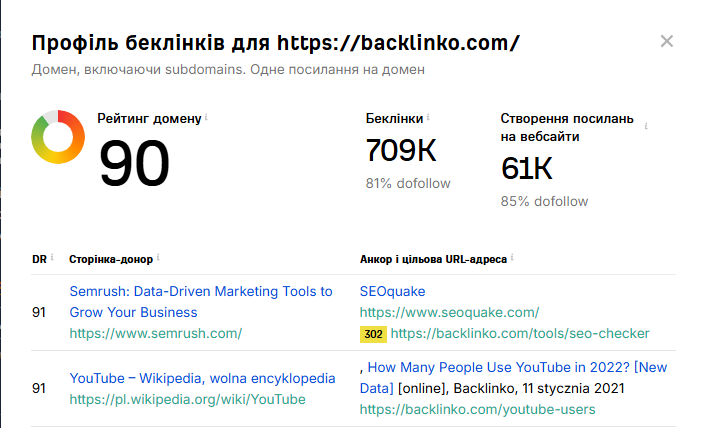
Domain Metrics
Use domain metrics as a guideline, not an absolute:
- Domain Rating (Ahrefs) — the relative “strength” of the link profile (0–100).
- Domain Authority (Moz) — predictive assessment of ranking probability.
- Trust Flow / Citation Flow (Majestic) — quality vs quantity of links.
Advice: compare TF/CF. A bias towards CF with low TF is a common indicator of weak donors.
Link relevance
Link relevance — the theme of the donor and recipient pages matches. The closer the content is to your offer, the stronger the signal.
Example: publication on a marketing blog with a link to the case Web Raketa — relevant; link from the building materials catalog — no.
Naturalness of links
Naturalness of links - a variety of anchors and sources, logical integration into the text and believable dynamics.
Natural links are a consequence of useful content; attempts at mass imitation are noticeable to algorithms.
— John Mueller (Google)
Distribution guidelines for anchor types (not the norm):
- Brand/URL: 50–70%
- Partial Keys/LSI: 20–40%
- Exact-match: up to 10%
Spam signals
- A sharp “stepwise” increase in donors.
- Identical anchor texts on multiple platforms.
- Suspicious TLDs and site networks.
- Pages with dozens of outgoing links and zero traffic.
- Low proportion of indexed pages on the donor site.
How to distinguish good links from bad ones
- Start with link relevance: topic, language, audience.
- Rate it domain metrics: DR/DA + TF/CF, organic trend, visibility.
- Check the donor page: traffic, indexing, position of the link in the text.
- Look at the donor's anchors and the number of outgoing links.
- Track the profile dynamics for 3-6 months: spikes/drops.
Practical advice
- Combine numbers and manual inspection. Domain Metrics cut out noise, manual verification solidifies the solution.
- Look at the transitions and indexing. A link without traffic is a weak signal.
- Balance anchors: more brand/URL, less exact-match.
- Keep the pace natural, without sudden bursts.
- Record decisions: why the link was accepted/rejected, what KPIs you expect.
As organic growth increases, platform stability is important. For projects on growth, use reliable hosting for content peaks - faster crawling and fewer crashes.
Link Quality Assessment Tools
"The best tool is one that helps you make decisions, not just shows you numbers."
- Ahrefs — donor depth, DR/UR, link history.
- Serpstat — profile monitoring, toxicity, anchors.
- Majestic — TF/CF and thematic link map.
- Semrush — Authority Score, Toxic Score, change monitoring.
Overview of tools
| Tool | Metrics | Free access | Price* |
|---|---|---|---|
| Ahrefs | DR, UR, Ref.domains, anchors | Limited | from $99 |
| Serpstat | SDR, Link Analysis, Toxicity | Yes (limit) | from $59 |
| Majestic | Trust Flow, Citation Flow | No | from £39 |
| Semrush | Authority Score, Toxic Score | Limited | from $119 |
Evaluation Process: Web Raketa Framework
Step 1 - Gathering Candidates
Export from Ahrefs/Serpstat/Semrush, search for brand mentions, analysis of top competitor donors, manual research of niche media.
Step 2 - Quick Scoring
Metrics (domain metrics DR/DA, TF/CF), organic trend, basic spam signals.
| Domain | Subject | DR/DA | TF/CF | Traffic/Visibility | Risk of spam | Summary |
|---|---|---|---|---|---|---|
| siteA.com | Marketing | 72/64 | 28/21 | Stable | Short | OK |
| siteB.net | Universal blog | 54/47 | 10/35 | Short | Average | Review |
| siteC.xyz | Miscellaneous | 18/9 | 5/41 | No | High | Reject |
Step 3 - Manual Check
Section relevance, link position (in text/footer/side), content quality, page indexing, internal linking.
Step 4 - Anchors and Naturalness
Plan naturalness of links: start — brand/URL, then partial keys; exact-match — targeted, for strong news items (research, case).
Step 5 - Monitoring and Adjustments
Check new/lost domains, toxicity, anchors monthly. Get rid of "gray" sites. Prepare disavow if necessary.
Common mistakes
- Focus on quantity, catalogues for show.
- Ignore link relevance and the quality of the donor content.
- Spamming exact-match anchors.
- Lack of monitoring and auditing.
- Belief in "magic" metrics without manual verification.
FAQ
What's more important—quantity or quality?
Backlink quality. Topical donors with traffic and natural context are more effective.
Which metrics are more reliable?
Combination: DR/DA + TF/CF, plus manual checking of relevance and traffic.
Is it possible to promote using only natural links?
Ah, but longer. Content marketing, PR, research, and case studies accumulate the naturalness of links.
Signs of a bad link?
Irrelevant topics, zero traffic, outgoing "dumps", identical anchors, mesh TLDs - classic spam signals.
Where to start with tools?
Serpstat or Ahrefs for the database, Search Console for indexing, Majestic for TF/CF.
How often should an audit be performed?
At least once a month. For active campaigns - once every 2 weeks.
Will Bad Links Hurt You in 2025?
Yes. A manipulative profile weakens the trust of algorithms and “holds” positions below potential.
Conclusion
Backlink quality — the foundation of safe and effective SEO. Check donors with numbers and eyes, maintain a balance of anchors and natural dynamics, monitor visibility and clicks.
Need a predictive audit and a 90-day plan? Team Web Raketa will help implement a process in which each link works towards a result.