171
171 1) What should a website for a construction company in Ukraine do: not be “pretty,” but generate applications
In short: website for a construction company In Ukraine, a website shouldn't just be "liked," but should consistently generate leads—from Google, ads, and recommendations. On this page, we'll explore how to view a website as a sales tool: what tasks it should accomplish, why "just a business card" almost always turns into a digital sign without incoming traffic, and how to think in terms of traffic that converts.
| What should be | Why does business need this? | What happens if not? |
|---|---|---|
| Services + clear offers | A person understands “what you do” and “why you do” | Compare with 3 competitors and leave |
| Portfolio objects with details | Trust and evidence of competence | "Beautiful photos" don't sell without context. |
| Lead forms, calls, messengers | Reducing friction before application | There is traffic, but no applications |
| On-demand SEO structure | Increased organic traffic and long-term visibility | Pay per click forever |
Who is it suitable for: Construction firms, repair companies, teams, and general contractors who need orders in specific Ukrainian cities (Kyiv, Lviv, Dnipro, Odessa, etc.) and a clear marketing ROI.
Who is not suitable: for those who want a “page for show”, without processing leads, without portfolio objects and without the readiness to manage reputation (reviews) and communication with the client.
A website is a sales department, just without the coffee breaks.
My opinion has been formed after dozens of projects: a construction company's website lasts only as long as you measure it not by "beauty," but by the bids and their quality. In construction and renovation, the solution is expensive, the risk for the client is high, which means the visitor has only one question in their head: "Can I trust you, and is it clear what will happen next?"
When we receive a renovation company's website after a designer, the diagnosis is usually the same: it's beautiful, but dumb. The "Submit a Request" button is hidden, there's no list of services, the estimate isn't even logical, and the portfolio is a mere "before/after" gallery without address, deadlines, materials, or tasks. As a result, traffic doesn't convert into leads. This is strategy, not chaos: we build the customer journey from inquiry to application.
Why a "business card" rarely works: in Ukraine, people buy confidence, not a page.
A business card might be fine if you're already attracting word-of-mouth leads. But as soon as you want to scale, the math begins. People search for specific terms: "turnkey apartment renovation," "facade work," "monolithic construction," "roofing," "commercial renovation." If your website doesn't have landing pages for these queries, no amount of "we build dreams" will boost organic traffic.
If a site doesn't respond to a customer's questions faster than its competitors, the customer isn't obligated to wait; they'll simply click "back."
Therefore, a website for a construction company should be designed for SEO and conversion: clear, structured, with evidence and a clear next step.
How to Think About "Traffic That Converts": A Website Task Checklist
In practical terms, a website should cover three key areas: attract, persuade, and engage. No mysticism or "magic buttons"—only manageable elements.
- Attract: pages for services, regions/cities, content for questions ("estimates," deadlines, stages), technical readiness for indexing.
- Convince: portfolio objects with details (task, budget/range, deadlines, materials), reviews, guarantees, team/permits.
- Convert: "Get an estimate" and "Calculate cost" forms, quick contacts, instant messaging, and a clear post-application flow.
And yes, "estimate" is one of the best triggers. But it shouldn't be "send me a number and we'll calculate it," but a proper exchange of value: what exactly you'll calculate, what input data is needed, and when the person receives a response. Then the site starts generating applications—predictably and in a mature manner.
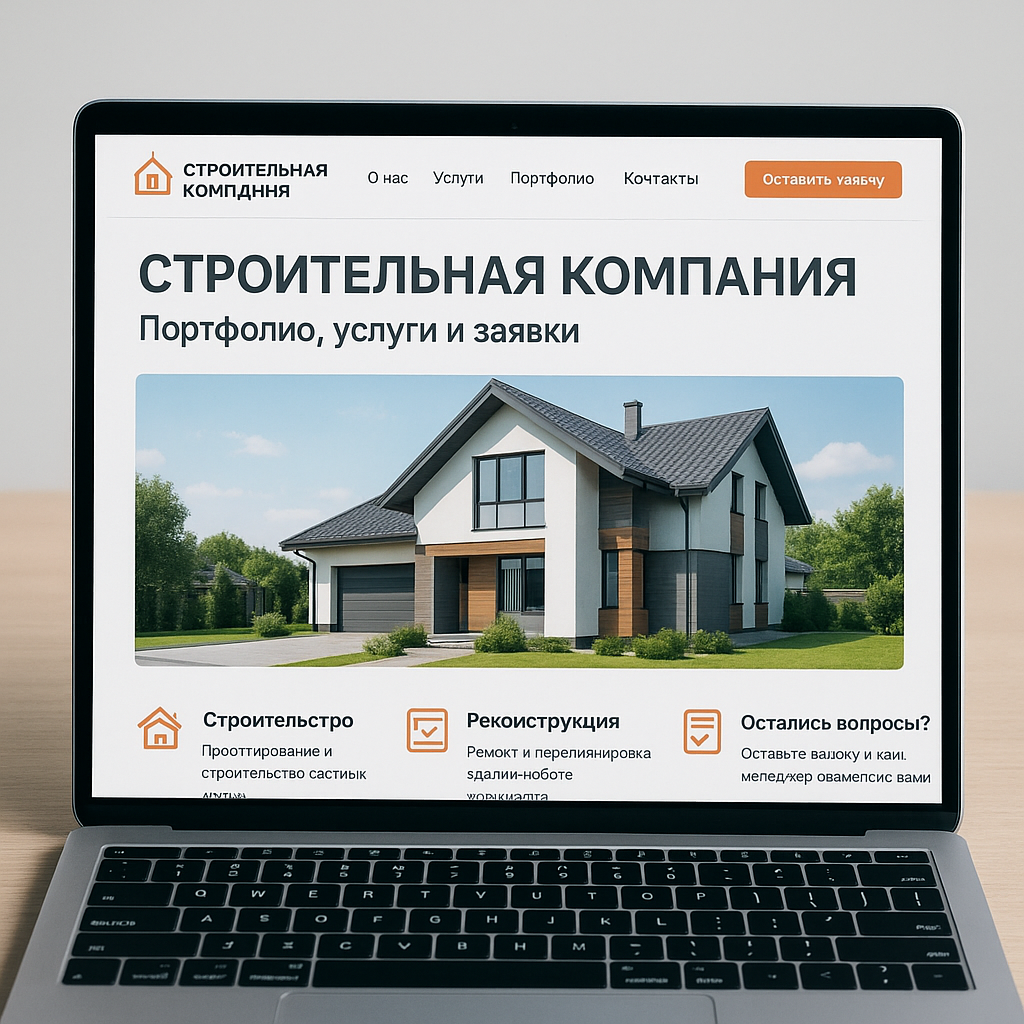
2) A structure that sells: services, estimates, trust, and a low-pressure CTA
Page framework: what's essential to get people to submit requests
If website for a construction company If it's assembled "by inspiration" rather than by decision-making logic, it begins to sell only one thing—hope. In construction and renovation in Ukraine, clients buy predictability: deadlines, cost, accountability, and a clear process. Therefore, the structure should lead the visitor from the question "Do you even do this?" to the action "Let's calculate my estimate" without pressure or manipulation.
A basic set of blocks that works in practice for both general contractors and website repair companies:
- Services are not “everything in a row,” but rather grouped: repairs (apartment/house/commercial), construction (frame/facade/roof/engineering) + separate pages for key areas.
- Estimate/calculation — a form or quiz with clear input data and a promised response time (for example, “within a business day”).
- Deadlines and stages — How do you manage a project: measurements → contract → purchase → work → delivery.
- Guarantees — what exactly do you guarantee and under what conditions (without “eternal guarantees”).
- Documents — licenses/permits/certificates (if relevant), details, contractual relations.
- CTA — 2–3 main actions: “Get an estimate”, “Order a measurement”, “Consultation” (and not 12 different buttons).
A transparent approach is important here: not “leave your phone number and we’ll tell you everything,” but “this is what you’ll get, this is what information you need, this is what happens next.”
We've seen in real projects that when CTA wording becomes more specific ("Calculate an estimate based on your plan/footage"), conversions increase without increasing the traffic budget. This makes it easier for people to make decisions.
Services and Geography: How to Get Found on Google by Ukrainian Cities
The "Services" page isn't a half-screen list. It's the foundation for systematic website promotion, tailored to the search demand already present in Google. Customers rarely search for "construction company." They search for "bathroom renovation Kyiv," "house construction Lviv," or "commercial renovation Dnipro." Therefore, the website must have a structure that aligns services with geography.
Practical minimum: separate pages for key areas + block “Cities/regions where we work” with specification of the format (on-site, remote estimate, teams on site). But it's important not to create dozens of empty "Kyiv/Odesa/Kharkiv" pages with identical text—this isn't about effective SEO, but rather about annoying users and risking search engine rankings.
“The same pages for different cities are like the same estimates for different objects: looks fast, but ends badly.”
Working approach: add real-world specifics to geo-pages—examples of properties in that city, travel times, logistics, and special conditions (e.g., working in new buildings, commercial spaces, or suburbs).
Estimate/Calculator/Quiz: How to Convert Traffic Without Pressure
Estimate — is the main "magnet" in the niche, but it needs to be sold honestly. The best option is a short quiz of 6-8 questions or a form with prompts: property type, area, condition, desired materials/level, start date, city. Then, a promise of results: "get a price range and a list of works" or "a preliminary estimate + questions for clarification."
Important: don't demand everything at once. A common mistake on repair company websites is a 12-field form with a mandatory phone number. Reduce friction: leave phone/messenger options as an option, add the option to attach a plan/photo, and add a micro-trust: "We don't spam, we don't share data, we respond during business hours." This is the traffic that converts, not the traffic "for the report."
Once the structure is in place, it's easier to scale: SEO for business, advertising, content—everything fits into a clear framework that doesn't throw off customers on the first screen.
3) Portfolio and objects: how to display your work so that people “buy” it, not just scroll through it
A construction portfolio is not a “gallery,” but an evidence base
In the construction industry, a portfolio is a key selling point. Not because it's "pretty," but because a client isn't buying bricks or tiles, but rather the confidence that you'll complete their project without any surprises. That's why a website for a construction company portfolio It should work as a mini-landing page for each case: with context, numbers, and execution logic.
From project experience: when a portfolio consists of "10 close-up photos of tiles," it's not a portfolio, it's a ceramics museum. The visitor scrolls through, sighs, and then moves on to a competitor whose listing says, "2-bedroom apartment, 62 sq. m., Kyiv, 8-week deadline, budget 18-22 thousand rubles. What we did and why." Context sells, not pixels.
“A photo without explanation is like estimate No work: looks impressive, but doesn't help you make a decision."
A strong portfolio also helps SEO: property cards are indexed, collect long queries (repair/construction + property type + city), and provide internal linking to services and build trust without unnecessary noise.
Object card: what to include to make your work "sellable"
To ensure your items aren't just scrolled through, but perceived as "yes, I want that too," each card needs to have a structure. You don't have to write a novel—an honest, concise outline is enough.
- Client's task: what was needed (for example, “renovations for rent” or “a house for permanent residence”).
- Geo: city/district (Ukraine, specific locality - if it can be disclosed).
- Deadlines: start/finish or duration + what influenced (waiting for materials, weather conditions, etc.).
- Budget: at least a fork (this removes unnecessary questions and saves the sales department time).
- Materials and solutions: what was used for insulation, what kind of engineering, what brands/classes of materials (without “the best”).
- Stages: 4–6 steps “how it was done” — from dismantling/foundation to delivery.
- Photo: “before/after” + several intermediate stages (they are more convincing than gloss).
- Team: who carried out the work (foreman, team, specialists), especially for complex jobs.
If you want to speed up conversion, add a CTA directly to the card: "Get a quote with a similar budget" or "Ask about the timeline for a similar project." This isn't pressure, but a logical continuation of interest.
Common Portfolio Mistakes (and How to Fix Them Painlessly)
The first mistake is "lumping everything together": renovations, facades, roofing, and commercial work all in one feed. The solution: filters by job type and separate categories. The second is a lack of figures. People don't ask for a precise price down to the last penny; they need a reference frame. The third is stock photos or photos "from the foreman's chat" in the "dark, crooked, but honest" style. Honesty is good, but basic visual hygiene is essential: lighting, angle, captions.
In practice, we have seen how after processing portfolio (Without changing the website design), organic and advertising conversions increase because people finally receive proof and understand the scope of the work. And then the construction company's website transforms from a "showcase" into a systematic promotion and sales tool.
4) Reviews and social proof: how to collect, format, and avoid looking suspicious
Why reviews in construction aren't just a nice-to-have, but critical to conversion.
In construction and renovation, a receipt is rarely just a trial run. The client pays upfront, endures noise, dust, and deadlines, and then remembers your project a year later when the baseboards come off (or don't come off). That's why reviews are one of the most powerful factors of trust: they alleviate fear and help you make decisions faster.
On a website for a construction company, reviews work as social proof next to portfolio and services. A portfolio answers "do they know how?" and reviews answer "how are they doing?" And this "how are they doing?" is key to sales, because the client chooses not only the hands but also communication, responsibility, and predictability.
If there are no reviews, or if they read like "Thank you for the quality repair. I highly recommend you." (without details or any indication of a real person), trust plummets. People in Ukraine have long been trained to recognize fake reviews—about as quickly as they recognize promotional price tags without the original price.
Review formats that appear honest and build trust
Optimally, combine several formats to cover different trust scenarios: some value Google, others live video, and still others only trust a "screenshot from a conversation." One thing is crucial: you must have the client's permission to publish and ensure there is no personal data that cannot be disclosed.
- Google Business ProfileReviews on a company profile are a strong signal of trust, especially for local searches by city. It's best to display a "View" widget/link on the website. reviews in Google”.
- Video review: 30–60 seconds, without a script, like in an ad. Let the person describe what they did, how long it took, what they liked, and what was difficult.
- Screenshot from the messenger: It works if there's context (what the object is) and personal data is hidden. And yes, there's no need to "draw" screenshots—it's noticeable.
- Case studyA hybrid portfolio and testimonial: the task, stages, and result plus a short client quote. Ideal for high-end projects.
To avoid looking suspicious, add "reality anchors": city, type of property, timeframe, and what exactly was done. Don't let the review be perfectly smooth. Overly perfect texts have exactly the opposite effect.
“A little truth in a review sells better than a ton of perfection.”
How to deal with negativity: Don't hide it, but manage your reputation
Negative reviews It's not the end of the world, but a test of a company's credibility. The mistake we've seen most often on projects is either ignoring it or responding with aggression. Both options are more damaging to trust than the negativity itself.
Practical algorithm: respond quickly, to the point, and calmly. Acknowledge the problem, clarify the details, offer a solution, and schedule the next step (call, on-site visit, warranty repair). If the review is clearly fake, ask for specifics (date, address/property, contract) and simultaneously file a complaint with the platform, but avoid the public "you're lying" attitude.
And most importantly: don't try to "drown" negative reviews with a dozen similarly positive ones. This looks like an attempt to cover your tracks. It's better to have 20 honest reviews and one negative one with a strong, professional response—that's the set for website for a construction company increases trust significantly better than a sterile display case.

5) SEO for a construction company: systematic website promotion, not the chaos of "repairs in Kyiv"
Why "Kyiv renovation" isn't a strategy, but a lottery with expensive tickets
SEO for a construction company is often reduced to a gimmick: "Let's rank for a couple of high-value keywords." In practice, it looks like this: a site tries to rank for "renovation Kyiv," "house construction," and a dozen other generic phrases—and then wonders why the wrong people are calling, or why no one is calling. Because Google doesn't reward those who are loudest, but those who more accurately address a specific search query.
Systematic website promotion is a strategy, not chaos: we build a structure based on services, types of objects and geography, and strengthen trust through content and portfolio, and only then we build up our authority with links. This gives increasing visibility in Google not “for a week”, but for months and years.
And yes, website for a construction company Without a proper technical base and clear landing pages, it will “move” like concrete without reinforcement: it may have been poured, but cracks will appear quickly.
Semantics, landing pages, and content: how to build effective SEO for Ukraine
It all starts with semantics: we collect queries not "as a whole," but by clusters. In construction, this is usually a combination service × object type × city × intention (price/estimate/timeframe/turnkey). Next, we create landing pages that actually answer the request.
A practical structure that most often results in increased organic traffic:
- Service pages: individual areas (apartment renovation, house renovation, commercial renovation, frame construction, facade, roofing, engineering).
- Geo-pages: not a “copy-paste for Ukrainian cities,” but with local cases/objects, travel conditions, and specific FAQs.
- A blog for clients' pain points: content that works for sales: “how to read an estimate”, “what the price is made up of”, “renovation time for 1-2 rooms”, “what is important in a contract”, “mistakes when choosing materials”.
- Portfolio as an SEO asset: Object cards catch the long tail of requests and increase trust.
Next, we enable internal linking: service → relevant objects → blog article → "get a quote" form. This is a simple mechanic, but it's what turns traffic into leads, not "looked at and left."
Technology, local SEO, and link building without the fuss
In Ukraine, a large share of construction traffic comes from mobile devices. Therefore, speed, Core Web Vitals, responsiveness, and clear call/messenger buttons are not just "wish listings," but conversion factors. Microdata markup (Organization/LocalBusiness, Breadcrumbs, FAQ) helps search engines better understand pages, and therefore supports them. increasing visibility in Google on competitive search results.
Local SEO — a separate layer: Google Business Profile, up-to-date NAP data (name/address/phone number), categories, property photos, Q&A, and regular posts. For many contractors, this provides a quick and inexpensive boost to incoming traffic specifically for the city.
As for links, quiet link building isn't about "buying 500 links." It's about carefully building authority: mentions in local directories, relevant media, partnerships with suppliers/designers, and case study publications. Links should support reputation, not create the impression that the site was "promoted in 2012."
"Strong SEO is like a construction site: first the foundation and design, then the floors. On the contrary, it's expensive and painful."
Once all of this is put together into a system, a construction company's website begins to generate organic traffic that converts: fewer random requests, more requests for "calculate an estimate" and "when can you start."
6) Frequently asked questions (FAQ) about the construction company website: deadlines, price, content, applications, support
What is more important for a construction company website: design or structure?
If I had to choose strictly one thing, it would be structure. Design is important, but like packaging: it builds trust when everything inside is logical. But structure is responsible for ensuring that people understand your services, see examples of your work, trust the process, and take action (application, call, quote). In practice, a weak structure "eats" even an expensive design: the visitor doesn't find what they need in 10-15 seconds and leaves. Therefore, we usually start with a prototype: what pages are needed, what blocks they contain, what CTAs, how we lead to the estimate, and portfolio — and only then do we draw beauty.
For website for a construction company This is critical: the niche is competitive, and trust is built on details (stages, deadlines, guarantees, real objects).
Do you need an estimate calculator and which is better: a calculator or a form?
An estimate calculator isn't always necessary. If you offer standard services (for example, turnkey renovations with clear price ranges), a calculator can be a good conversion tool. But if each project is unique (private homes, complex engineering, custom materials), a quiz or form with a choice of parameters and the promise of "we'll give you a range + follow-up questions" is more reliable. It's important not to mislead with a precise figure "down to the hryvnia" if you'll recalculate it anyway after the measurements. It's better to provide a range and a breakdown of what's included. This approach improves the quality of leads and reduces the number of conflicts "at the start."
Another point: a calculator isn't just a block on a page. It needs to be maintained, its logic and pricing updated, otherwise it will start to generate mistrust. Therefore, sometimes it's better to simply "get an estimate in 1 business day" and collect the data carefully than to build a complex tool without the resources to maintain it.
When will applications appear, what should I prepare, and how should I connect everything with analytics/CRM?
Applications depend on sources. If you enable advertising, the first inquiries may occur within a few days after launch, but the quality will depend on how you configure filters, geolocation, and landing pages. If you're focusing on SEO for a construction company, it's a multi-month process: first, indexing and increased visibility, then a steady organic flow. A strong website portfolio, detailed service pages, and local signals across Ukrainian cities accelerate the process.
“SEO can’t be turned on with a button, but it can be turned off only at your initiative.”
What to prepare in advance: photos of the projects (preferably before/after and stages), brief descriptions of the work performed, including the city and timeframe, a clearly defined list of services, answers to frequently asked questions from clients, documents/warranty terms, contact information, and geographic coverage. If there's not enough content, that's okay, but then plan to add content in stages to prevent the site from looking empty.
In terms of measurability, be sure to use GA4, Google Search Console, button events (calls, messengers, form submissions), and call tracking for advertising. It's best to send requests directly to your CRM (or at least to a spreadsheet/email + Telegram) to avoid losing leads. For security and support: regular CMS/plugin updates, backups, brute-force protection, SSL, and access control. A construction company's website is a working tool, and it should be protected like a car: without maintenance, you won't get far.
7) Conclusion: What kind of website does a construction company need to receive stable orders?
Website for a construction company In Ukraine, a consultant isn't needed "just to be there," but rather to regularly generate inquiries that can be processed and developed into contracts. In this niche, the most creative doesn't win; the most understandable wins: the one who quickly explains services, shows real projects, and alleviates client anxiety about deadlines, budgets, and responsibilities. A "business card" without structure usually remains a digital sign: traffic comes, looks, and leaves—because they don't see the next step or evidence.
The working formula looks simple, but requires discipline: a strong portfolio (not a gallery, but cases with context), services with normal landing pages, transparent calculation logic estimates and social proof through reviews. When these elements are combined into a single system, visitors stop "comparing prices in a vacuum" and start comparing approaches—and that's your territory if you're truly skilled at your craft.
- A portfolio sells competence and scale: task, deadlines, budget/range, materials, stages, geo.
- Services and CTAs generate conversions without pressure: “get a quote,” “order a measurement,” “discuss deadlines.”
- Reviews and dealing with negativity increases trust: it's better to be honest and to the point than perfect and suspicious.
- SEO for a construction company provides long-term visibility: semantics, city structure, content that drives sales, interlinking, local SEO, and link building without unnecessary noise.
Web-Raketa's approach is all about control and measurability: we don't build a "pretty shell," but a system that clearly identifies where traffic is coming from, what it does on the site, and where exactly it converts into a lead. No promises of magic or "guaranteed top rankings": only strategy, transparent actions, and measurable growth. The irony is that the best compliment for such a website is something dull: "It just consistently generates leads." In construction, this is the hallmark of professionalism.